Crocs Workplace Compliance Checker
Configuration
Assessment Result
Select your details on the left to see if your footwear meets Irish standards.
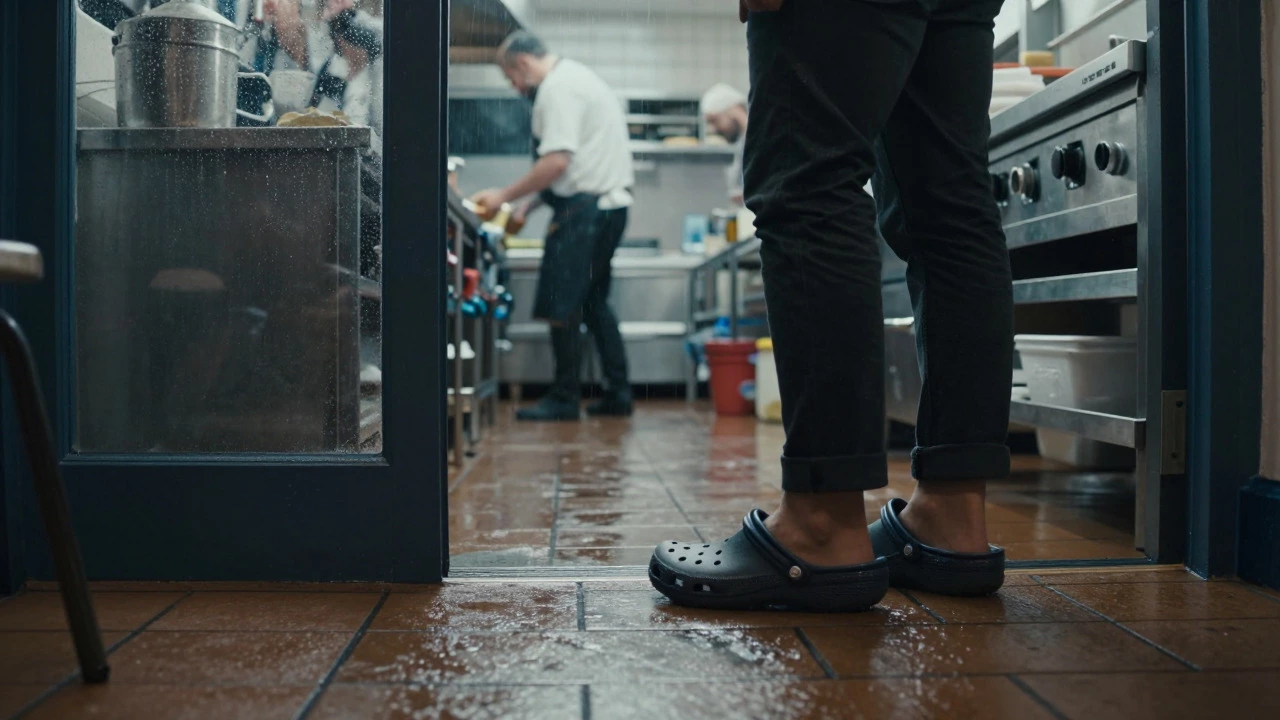
Picture this: it’s 4 PM on a rainy Tuesday in Dublin. You’re working the line at a busy café in Temple Bar or scrubbing floors in a hospital ward in Galway. Your feet are throbbing, and you’re eyeing your trusty pair of Crocs-the foam clogs that have become a uniform for nurses, chefs, and retail workers across the island. But then a manager stops you. "Take those off," they say. "They’re a health code violation." Is there any truth to that? Or is it just another workplace myth?
If you’ve ever worked in food service, healthcare, or hospitality in Ireland, you’ve likely heard the debate. The short answer is no, wearing Crocs is not automatically a health code violation under Irish law. However, the longer answer involves specific regulations from the Health Service Executive (HSE), local city councils, and individual employer policies that can make or break your shift.
Why do people think Crocs violate health codes?
The confusion stems from the open-toe design of many casual Croc styles. Health and safety guidelines generally require closed-toe, non-slip footwear to protect against spills, dropped objects, and contamination. Because some Crocs look like beach sandals, managers often assume they don’t meet professional standards.
The Irish Legal Landscape: What Actually Says What?
To understand if your footwear is compliant, we need to look at who sets the rules. In Ireland, there isn’t one single "health code" that applies to every job. Instead, different bodies regulate different sectors. For food businesses, the Food Safety Authority of Ireland (FSAI) provides guidelines, but enforcement often falls to local authorities like Dublin City Council or Cork County Council. For healthcare workers, the HSE has strict occupational health and safety protocols.
The core legislation governing most workplaces is the Safety, Health and Welfare at Work Act 2005. This act requires employers to provide Personal Protective Equipment (PPE) where risks exist. It doesn’t explicitly ban Crocs, but it does mandate that footwear must be suitable for the task. If you’re handling raw chicken in a deli in Limerick, standard plastic Crocs might not offer enough protection against heavy knives or slippery floors compared to dedicated safety shoes.
So, while the law doesn’t scream "No Crocs!" it leaves room for interpretation based on risk assessment. This is where things get tricky for employees. A restaurant owner in Kilkenny might decide that any shoe with holes is a hygiene risk because debris can fall through. That’s their prerogative as long as it’s documented in their safety policy.
Crocs Professional vs. Classic: Does Style Matter?
Not all Crocs are created equal when it comes to compliance. The brand actually produces a line called Crocs Professional, specifically designed for healthcare and industrial environments. These models often feature:
- Closed-toe designs: No holes mean less chance of contamination or injury.
- Non-slip outsoles: Tested for wet environments, crucial for kitchens in rainy cities like Galway.
- Easy-clean materials: Resistant to bodily fluids and chemicals.
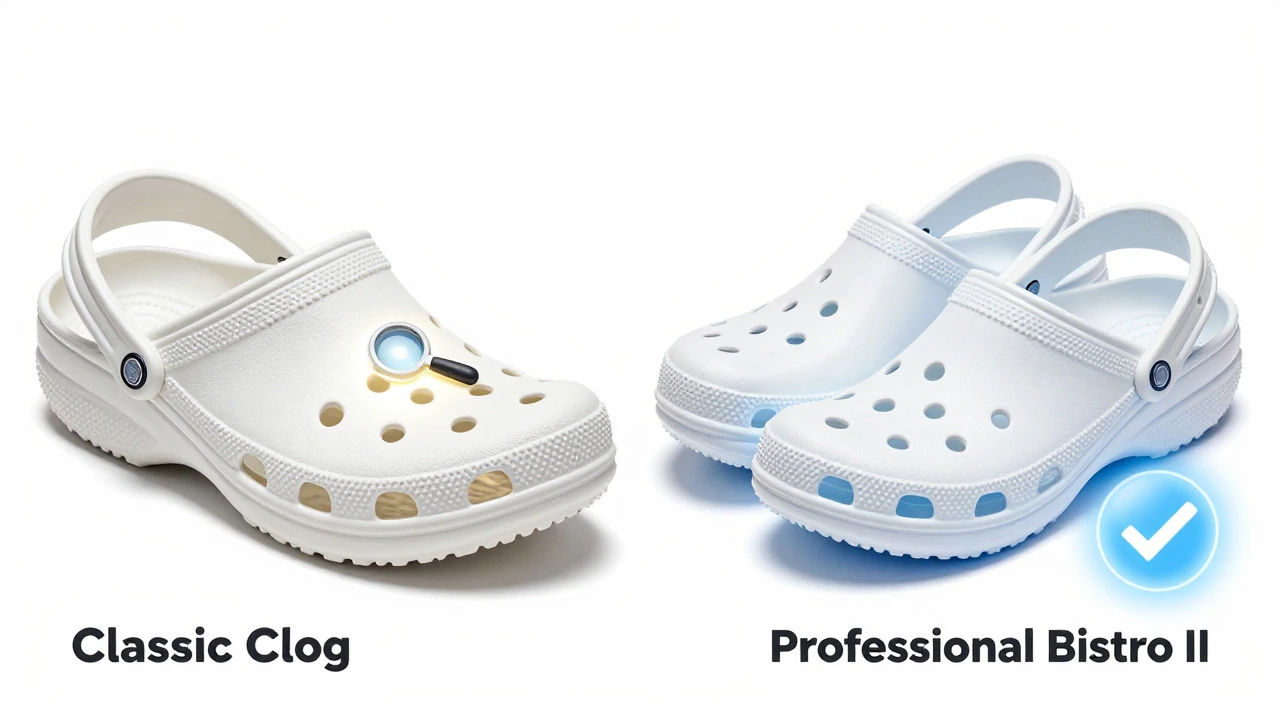
If you’re wearing the classic "Classic Clog" with ventilation ports, you’re walking into potential trouble. Those holes can trap bacteria, hair, or food particles, which violates basic hygiene principles outlined by the FSAI. In contrast, the closed-toe Bistro or On-The-Clock models are far more likely to pass inspection because they seal the foot from the environment.
| Style | Holes/Vents | Sole Grip | Typical Acceptance in Ireland |
|---|---|---|---|
| Classic Clog | Yes | Moderate | Often rejected in food/healthcare |
| Bistro II | No | High (Non-slip) | Widely accepted in kitchens |
| On-The-Clock | No | High | Standard for HSE nurses |
| LiteRide Clog | Yes | Moderate | Accepted in retail, rare in hospitals |
Sector-Specific Rules: Healthcare vs. Hospitality
Your industry dictates your footwear rules. Let’s break down how this plays out in two major sectors in Ireland.
Healthcare: The HSE Standard
Nurses and carers in Ireland spend up to 12 hours on their feet. The HSE recognizes this and has historically been lenient regarding comfort, provided safety isn’t compromised. Many staff at University Hospital Galway or Beaumont Hospital in Dublin wear Crocs Professional models. Why? Because they’re lightweight, easy to sanitize, and reduce fatigue.
However, the rule is simple: no holes. If a needle sticks through a vent, or blood splashes inside, it’s a biohazard. Most HSE trusts now specify that footwear must be fluid-resistant and closed-toe. So, if you’re a nurse, check your contract. If it says "closed-toe shoes only," your vented Crocs are technically a violation, even if everyone else wears them.
Hospitality: Kitchen Hygiene
In restaurants, pubs, and cafes, the stakes are slightly different. Here, the focus is on preventing foreign object contamination. Imagine a piece of glass or a metal shard falling onto a prep table. If your shoe has holes, could something fall through and contaminate food below? Unlikely, but possible. More importantly, grease and water mixtures create slip hazards.
A popular gastropub in Cork might allow Crocs if they’re clean and non-slip. A high-end Michelin-starred kitchen in Dublin might ban them entirely due to aesthetic standards or stricter internal policies. Always ask your head chef. In Ireland, the "boss knows best" culture still prevails in small businesses, overriding general guidelines.
Practical Tips for Staying Compliant
Want to wear Crocs without getting fired or fined? Follow these steps tailored for the Irish market:
- Check your employee handbook: Look for sections on "Personal Protective Equipment" or "Uniform Policy." If it mentions "closed-toe," stick to Bistro or On-The-Clock models.
- Invest in Jibbitz wisely: While fun, decorative charms can harbor bacteria if not cleaned regularly. In sterile environments, keep them minimal.
- Clean them daily: Use antibacterial wipes. Irish weather means mud and rain; bring dirty shoes indoors, and you’re inviting pathogens.
- Know your rights: Under the Safety, Health and Welfare at Work Act, if your employer bans comfortable shoes without providing free alternatives, that could be a breach of duty. Document everything.

Alternatives if Crocs Are Banned
If your workplace in Ireland strictly prohibits Crocs, you’re not stuck with painful dress shoes. Several brands offer excellent alternatives that meet Irish safety standards:
- Skechers Work: Known for memory foam and slip-resistant soles, widely available in Brown Thomas and online.
- Teva Hurricane XLT2: Great for outdoor roles, though less common in hospitals.
- Dr. Martens AirWair: A cultural staple in Ireland, offering durability and style, though heavier than Crocs.
- Clarks Unstructured: Comfort-focused, often sold in Clarks stores across Irish shopping centers.
When buying, look for the SRA (Slip Resistance Assessment) rating. This ensures your shoes meet British and European safety standards, which are recognized in Ireland post-Brexit.
Final Thoughts: Comfort Meets Compliance
So, are Crocs a health code violation in Ireland? Not inherently. But context is king. A pair of vented Classics in a sterile operating theater is a problem. A pair of closed-toe Professionals in a busy pub kitchen is often a solution. Know your role, know your risks, and always prioritize safety over trendiness. After all, nothing ruins a shift faster than a slip-and-fall on a wet floor in a Dublin alleyway.
Can I wear Crocs to work in a hospital in Ireland?
Yes, but usually only the closed-toe, non-slip Professional models. Check with your specific HSE trust or private hospital’s HR department, as policies vary by site. Vented styles are often banned due to infection control risks.
Do Irish restaurants require steel-toe boots?
Most casual restaurants do not require steel-toe boots unless you’re moving heavy kegs or equipment. However, non-slip soles are mandatory in almost all professional kitchens to prevent accidents on wet surfaces.
What happens if I wear wrong shoes to work?
You may be asked to change immediately. Repeated violations can lead to disciplinary action under company policy. In extreme cases, if an accident occurs due to improper footwear, liability issues could arise for both employee and employer.
Are Crocs considered professional attire in Ireland?
In creative industries, tech startups, or casual retail, yes. In corporate offices, law firms, or formal hospitality, generally no. They are viewed as functional workwear rather than fashion statements in professional settings.
Where can I buy safety-approved Crocs in Ireland?
You can find them on the official Crocs Ireland website, in larger branches of Boots or Superdrug, and sometimes in specialized workwear stores like Toolstation or Wilko. Always verify the model number matches professional specifications.